
Within our Bioenergy business area, we make use of renewable by-products from forestry and sawmills and process them into biofuels for energy and heat production.
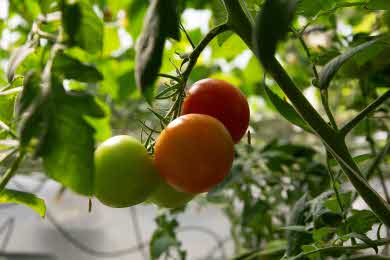
Tomatoes grown with renewable pellet heating
- Article
- Renewable Energy
At Ljustorps Tomater, pellets provide the energy that heats the soil, growing containers, and greenhouse air. Eva and Jorge produce around 14 tonnes of tomatoes each season: pesticide-free, carefully cultivated, and grown using heat generated from renewable wood pellets.
Ljustorps Tomater was founded in 1989 by Eva’s parents. Today, Eva and Jorge run the business, growing, harvesting, and packing around 14 tonnes of tomatoes every season. In addition to fresh vegetables, they produce and sell ketchup, pickles, marmalade, and tomato sauce, all made from their own harvest
A family business focused on flavour, not volume
Ljustorp Tomatoes was founded in 1989 by Eva’s parents. Today, Eva and Jorge run the business. Each season, they grow, harvest, and pack around 14 tons of tomatoes. In addition to fresh vegetables, they also sell ketchup, pickles, marmalade, and tomato sauce – all made from their own produce.
The family business is a busy operation, running seven days a week from March to September. Their days are filled with caring for the plants, managing pests, harvesting tomatoes, packing and selling produce, and keeping the café running.
Eva’s mother is still actively involved in the business. She bakes all the bread served at Café Pomodoro during the summer season. And naturally, pomodoro means tomato.
“The best part of this job is being your own boss and meeting so many wonderful people,” says Jorge. Running a family business also comes with a lot of responsibility. "There is very little room for error,” Jorge explains. “If the irrigation system were to fail for even a single day, the entire season could be lost.
Today, they grow around 20 different tomato varieties, ranging from large beefsteak tomatoes to small cherry tomatoes. Eva and Jorge prioritize flavour over yield, choosing varieties known for their exceptional taste rather than maximum production
The transition to pellets
The greenhouses were originally heated with oil, which was the recommended choice when Eva’s parents first invested in the operation. At the time, established technology was considered the safer option.
Ten years ago, Eva’s parents made the decision to replace oil with locally produced pellets, significantly reducing the business’s reliance on fossil fuels. The conversion was relatively straightforward, as the existing oil boilers could be fitted with pellet burners.
“Purpose-built pellet boilers would provide even better performance, but for a small family business that represents a major investment,” says Jorge.
The greenhouse heating system consists of three boilers, all fuelled by pellets. Two 200 kW pellet boilers distribute heat throughout the greenhouse via fans. The third boiler provides underfloor heating and is the first to be started each season. The soil in the greenhouses is warmed first, followed by the containers in which the tomato plants are grown.
Greenhouse-grown tomatoes at Ljustorp Tomatoes
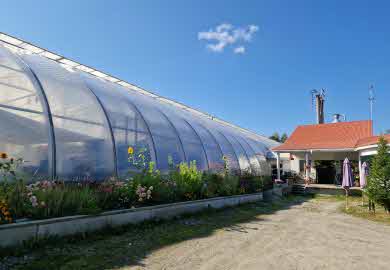
The greenhouse and the café
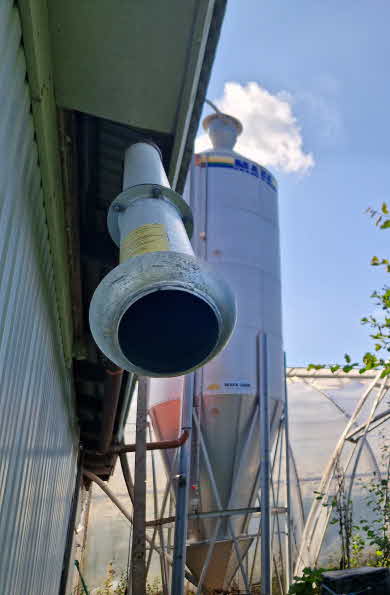
Bulk fill connection at the pellet silo
Eva shows a long-shaped tomato variety, Portento. It’s an Italian tomato that’s a bit meatier and works great in pasta and soups.
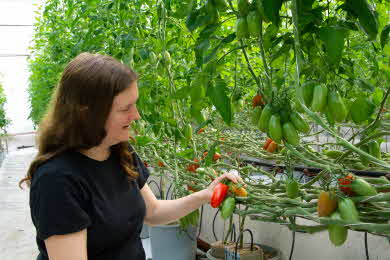
Greenhouse-grown tomatoes at Ljustorp Tomatoes
Thoughtful choices throughout the business
Having multiple boilers provides an essential backup system. A reserve electric heating element is also available for the underfloor heating system, powered by electricity from renewable energy sources.
“We try to make thoughtful choices when it comes to our energy use,” says Eva
orge explains that they have never used chemical pesticides. Instead, they rely on biological pest control, introducing beneficial insects that help keep harmful pests under control naturally.
Water and nutrients are supplied to the growing containers through a pipe system. One of the advantages of using growing containers is the ability to precisely manage nutrient delivery to the plants and recover excess nutrients. Any surplus nutrient solution is collected from the containers and returned to storage tanks, where it can be reused.
“We don't use organic fertiliser yet, but the fertiliser is part of a closed-loop system, allowing us to recover and reuse it while reducing emissions to the surrounding environment,” says Eva.
A lot of buzz at the local shop in Ljustorp
Bumblebees play an important role in pollinating the tomato flowers. So how do you attract bumblebees into the greenhouses?
“We simply order them online, and they arrive in packages at the local shop,” Eva says with a smile.
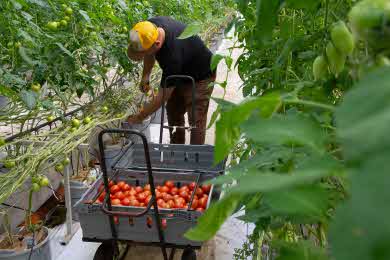
Jorge picking tomatoes
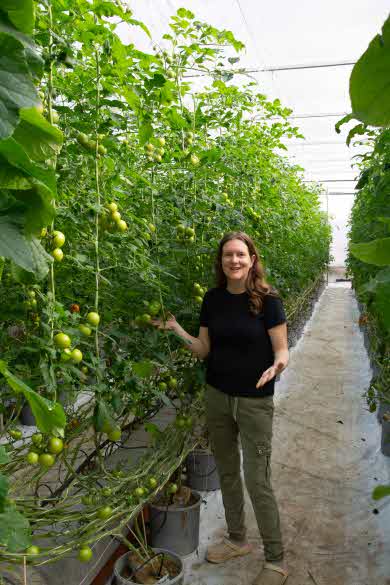
Eva showing the plants
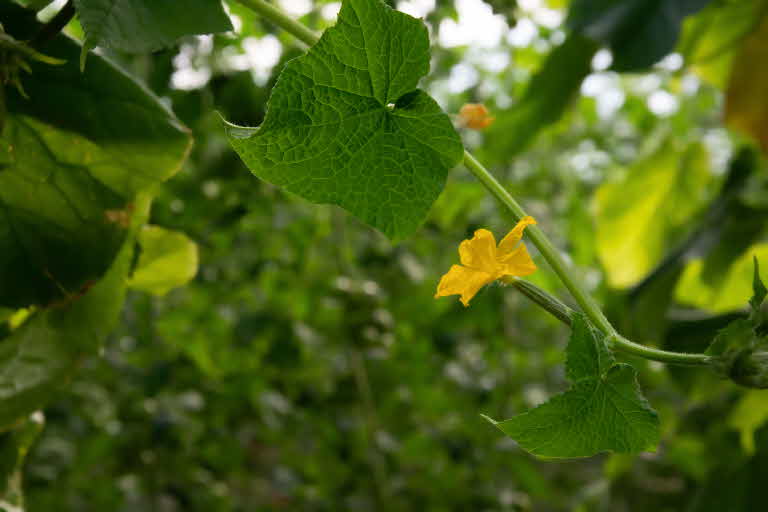
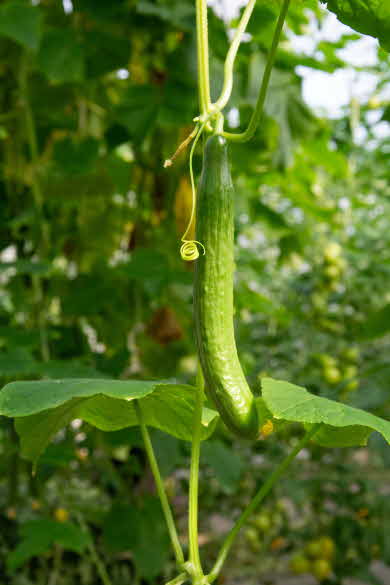
Cucumber
Jorge picking tomatoes
The greenhouse year cycle
When SCA visited in September, all that remained was to let the final tomatoes ripen. After that comes a period of maintenance, cleaning, and a well-earned holiday before the next growing season begins.
The greenhouses are left unheated during the winter months. According to Eva, a few days of temperatures as low as -20°C are actually beneficial, helping to eliminate any pests that may have survived the seasonal clean-up.
By March, the pellet silo, which holds 16.5 tonnes of pellets, needs to be fully stocked. The growing season begins by starting the ground heating loops and gradually warming up the greenhouse. New plants are then delivered, and the seedlings they have raised themselves are set out.
“The aromas are wonderful, and greenhouse life begins again,” says Eva with a smile.
Throughout the season, the temperature inside the greenhouse must be maintained at a minimum of 18°C.
“The pellet deliveries from SCA work well, and so far we've never failed to keep the temperature where it needs to be,” says Eva.
The pellet deliveries from SCA have been reliable and so far, we’ve never failed to keep the heat up.
Related content

Pellets for heating and energy production
Pellets are a standardized biofuel made from sawdust and planer shavings generated by the wood-processing industry. Through drying and compression, the raw material is transformed into a compact fuel that is easy to store and transport. The consistent fuel properties of pellets provide predictable conditions for combustion and energy production.

Bioenergy for businesses
SCA’s extensive forest holdings and sawmill operations provide a stable, long-term supply of renewable by-products that can be used for energy generation. We offer both forest-based biofuels, such as logging residues and stemwood chips, and sawmill-based biofuels, including bark, sawdust, and pellets.